Water on Giclee Canvas

Dezhere

Grumbler
Joined
Mar 15, 2021
Posts
28
Loc
Juneau
Business
Picture This
Ulgh, I hate even asking this question, but my customer has begged me to ask my peers:
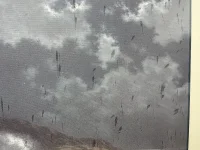
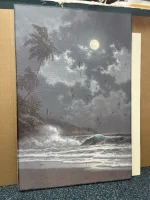
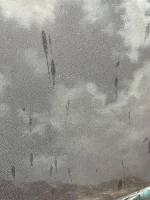
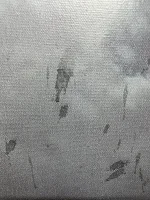
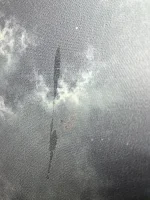
Customer brought in a 30 year old embellished giclee print asking is I will repair a small rip in it. On the way into the shop, SHE did not cover it (I could have given her a bag easy) and some rain drops got on it. Now the rip is not the biggest problem, the water stains are. There are maybe 40-50 rain spatters all over it. I ran to her with a paper towel as I saw her come in, but before I let her rub all over it, I tested to see if it was water based and would smear. It is and it does. Even a slight touch removed the color. So we left it to air dry. Now the dried rain drops have left a darker color, just like it looked when it was wet. Its been drying for 3 weeks now. This is how it looks.
On top of the rip and the rain drops, it is horribly sun damaged.
I personally would absolute toss it and call it a day, in fact I have tried to convince the owner this. But of course its her husbands super favorite and has more sentimental value than just the image its self. So she does not want a replacement (I have found one), or a scan and reprint (yes yes I know this is wrong!), or ANYTHING but this exact canvas.
I have wondered if varnishing would hide them; test spot on side makes no change in the color difference of the spot vs backdrop. She has gotten to the point of asking me to paint over each rain spot. I of course refused. I will do VERY small touch ups on inexpensive art (go ahead, you hardcore-ests yell at me, but I am damn good AND we live in a very remote area of the world) but I am absolutely not going to completely repaint this whole friggin canvas! My customer is not mad at me or holding me responsible, in fact she is very grateful stopped her from smearing the whole thing. But it is a rare thing to have something that feels so completely unfixable. Normally if I can't do it, a conservator can. I think this could be one that is a lost cause.
So, my question is, does anyone have a super secret way of removing or hiding these rain drops? I will ALSO reach out to a conservator for advise/quote/anything :D
Thank you!!
 

Attachments

  • IMG_3085.webp
    IMG_3085.webp
    441.6 KB · Views: 41
  • IMG_3086.webp
    IMG_3086.webp
    157.8 KB · Views: 37
  • IMG_3084.webp
    IMG_3084.webp
    308.7 KB · Views: 40
  • IMG_3087.webp
    IMG_3087.webp
    166.2 KB · Views: 43
The request by your customer is beyond the scope of a mortal picture framer.

If you were to contact a paper conservator to evaluate it, even though it appears to have been printed on fabric, I would highly think that they not take on such a challenge.
 
The request by your customer is beyond the scope of a mortal picture framer.

If you were to contact a paper conservator to evaluate it, even though it appears to have been printed on fabric, I would highly think that they not take on such a challenge.
Roger. I agree completely.
I'm pretty sure when I talk to a conservator (because the owner is so desperate she is paying me to ask them) they will laugh me off. But thanks for replying!
 
It's an unfortunate circumstance when the customer is the one who does more harm just getting the piece to our shops without adequate care.
It's easy to say "It's her fault! ", but in this case that would be unkind and not at all useful.
I'm sure she already feels badly about what happened to a piece that is important to her family.

You have really gone above and beyond in careing for your customer.
But yes, there is only so much you (or anyone) can do.

You've offered solutions, but they were rejected.
At a certain point you'll have to simply say "I've done all I can. This is not repairable. You can keep it as it is now, or replace it."

Honestly, seeing how badly faded the piece has gotten anyway, plus the rip, and now the water marks, replacing it with a new one would probably bring them more enjoyment to see that artwork as it originally looked, rather than the faded, batttered, and stained thing it is now.

Is there any way you could show her a comparison between what she has and what a replacement would look like side by side?
It might sway her decision to a more practical resolution.

Best of luck
 
I wonder if the original source could be located and printed again, restored to its original full color glory?

The amount of fade on that piece is a pretty good argument to frame the future one under protective glazing.

We stopped printing on canvas several years ago, in our shop, and this was one of the reasons.
 
In defense of Art Conservators having limitations, When I took a 2 week workshop(2 separate courses back to back) sponsored by the Inter-Museum Lab near Cleveland there was a visit to the Cleveland Art Institutes Conservation lab to examine an original period Dutch Ripple frame. It happened to have it's original painting in it.... An original Rembrandt painting on a table that we all gathered around to see. On another much smaller table was a storage box with an original Degas pastel with extensive damage. We discussed this item as well as part of our visit. The conclusion of the museum staff was that it would be stored, as-is, in the storage box "forever" as in their opinion it could not be restored due to surface damage of the art on the paper that was not damaged.
 
This may not be the information you want to share with your customer, but by definition, a giclée print should be produced with archival pigment inks, which should not dissolve from exposure to a few drops of water. In addition, any embellishment applied to the surface should have provided an extra layer of protection for the print. A reprint or copy would be the best option. If copyright isn't a problem look for a Pro level photo lab or reprographic print shop.

Good Luck.
 
I am an artist, not a conservator or a framer. Given that it sounds as if this 'particular' canvas, is of high sentimental value to the client, and that they were not bringing it in to fix the fading (if I understood your post), and assuming that this is not from a notable artist (as I assume proper archival inks would have been used by a professional) and as such does not have any high monetary value.. then if she does not want to take it to a conservator, or they do not want to take it on, I would suggest she could take it to a good artist who might be willing to touch it up (ideally the original artist if they know who that is and can contact them, if they are still around being 30 years old). If the canvas has been varnished, it would not be ideal painting over the varnish, but that can be hard to tell. Water should not damage a giclee print on canvas, and if varnished. again that should be waterproof. One question, as photos dont show as much detail... the fact that the spots have gone a dark grey... the surface of that canvas is not dirty is it? Water has not simply turned black dust to black dried mud as such? It just seems a bizarre reaction to the water drops. Good luck!
 
The original high speed inkjet prints, Iris Prints, were made with water soluble inks, and they were very prone to fading.
The cautionary tale here is to avoid making their problem yours.
 
Hard to tell, and I agree with Natasha above that is seems weird that the raindrops turned so dark.

The only thing you can try is to rub some pastel dust on the spots (test a small inconspicuous area first) in the right color. This customer clearly doesn't want a reprint, so there is only so much you can do to make this look better.

At that point, I would recommend glazing and a frame (I use stacked frames and sandwich glass in between but you can use a spacer to keep the glass off the print). The pastel will otherwise not last on this, if exposed to the elements.
 
Natasha5
The chemistry of inks used in the 1990's were not necessarily the same as what is being used today. The OP did not specify the printer that was used nor what inks were used. Yes, I remember many water soluble inks were used in the beginning.
 
It's an unfortunate circumstance when the customer is the one who does more harm just getting the piece to our shops without adequate care.
It's easy to say "It's her fault! ", but in this case that would be unkind and not at all useful.
I'm sure she already feels badly about what happened to a piece that is important to her family.

You have really gone above and beyond in careing for your customer.
But yes, there is only so much you (or anyone) can do.

You've offered solutions, but they were rejected.
At a certain point you'll have to simply say "I've done all I can. This is not repairable. You can keep it as it is now, or replace it."

Honestly, seeing how badly faded the piece has gotten anyway, plus the rip, and now the water marks, replacing it with a new one would probably bring them more enjoyment to see that artwork as it originally looked, rather than the faded, batttered, and stained thing it is now.

Is there any way you could show her a comparison between what she has and what a replacement would look like side by side?
It might sway her decision to a more practical resolution.

Best of luck
I have not shown her what the replacement looks like, that is a good idea. I'll do that. Thank you!
 
Natasha5
The chemistry of inks used in the 1990's were not necessarily the same as what is being used today. The OP did not specify the printer that was used nor what inks were used. Yes, I remember many water soluble inks were used in the beginning.
Interesting, thanks!
 
In defense of Art Conservators having limitations, When I took a 2 week workshop(2 separate courses back to back) sponsored by the Inter-Museum Lab near Cleveland there was a visit to the Cleveland Art Institutes Conservation lab to examine an original period Dutch Ripple frame. It happened to have it's original painting in it.... An original Rembrandt painting on a table that we all gathered around to see. On another much smaller table was a storage box with an original Degas pastel with extensive damage. We discussed this item as well as part of our visit. The conclusion of the museum staff was that it would be stored, as-is, in the storage box "forever" as in their opinion it could not be restored due to surface damage of the art on the paper that was not damaged.
Great example. Thank you!
 
I wonder if the original source could be located and printed again, restored to its original full color glory?

The amount of fade on that piece is a pretty good argument to frame the future one under protective glazing.

We stopped printing on canvas several years ago, in our shop, and this was one of the reasons.
I have never been a printer, so thats very interesting.
The artist still has a gallery and is still selling. I have suggested we call them to see what they can do for a replacement. She is not interested.
Like others have said, there's only so much I can do as a framer and within her requests. One of her requests was for me "to ask my peers" if there is a fix. This forum and a few other calls I have made will complete that request, and maybe will spur her onto getting a replacement. Thanks for responding!
 
I agree with Wally - A 30-year-old giclée on canvas is almost certainly early Iris dye ink. That’s why the ink moved with raindrops and why the sun cooked it. So the rain probably either:

(1) Moved the dye around, which usually leaves a dark ring at the edge of each drop. That’s permanent, so only retouching will fix it.
(2) Changed the surface. The water swelled the coating or partly dissolved the matte topcoat. When it dried smoother, it started reading darker, the same way anything looks darker wet.

You said the spots are evenly darker, “like it looked when it was wet,” and you didn’t mention rings. That sounds like #2, and it’s why three weeks of drying hasn’t changed anything.

Try putting a raking light on it and if the spots have a different sheen than the area around them, it’s probably #2. Even out the sheen and the spots can mostly disappear.

Your varnish test was on the side, so it probably didn’t tell you much. Test right over a couple of drops and see whether an even coat (all gloss or all matte) makes the drops blend in.
 
I am an artist, not a conservator or a framer. Given that it sounds as if this 'particular' canvas, is of high sentimental value to the client, and that they were not bringing it in to fix the fading (if I understood your post), and assuming that this is not from a notable artist (as I assume proper archival inks would have been used by a professional) and as such does not have any high monetary value.. then if she does not want to take it to a conservator, or they do not want to take it on, I would suggest she could take it to a good artist who might be willing to touch it up (ideally the original artist if they know who that is and can contact them, if they are still around being 30 years old). If the canvas has been varnished, it would not be ideal painting over the varnish, but that can be hard to tell. Water should not damage a giclee print on canvas, and if varnished. again that should be waterproof. One question, as photos dont show as much detail... the fact that the spots have gone a dark grey... the surface of that canvas is not dirty is it? Water has not simply turned black dust to black dried mud as such? It just seems a bizarre reaction to the water drops. Good luck!
Good question.
Unfortunately any varnish it may have had has been so sun damaged (or never applied?) it has become inapplicable. It is not the cleanest canvas I have seen, but not all that dirty. Not a layer of dust or anything over it. If it had been properly varnished/sealed I don't think we would have this problem now. I think what may have happened is the water reactivated the ink and then, for a lack of the real word, re-smoothed out again...? Making it surface area hold the light different...? Or soak into the backing differently...? I have not confirmed this, just an idea. I wish I had a conservationist accessible so I could show them (I live in a town with no roads in or out).
Also, just an interesting thing you might like to know as an artist; as I understand it, if this were a real painting a conservator would normally remove any varnish to clean it, and then revarnish the canvas before doing any touch ups so that a future conservator can clearly see where the changes have been made and can remove them again if wished. Fascinating, right?
I know tons of artist, so I will see if any want to repaint it. I think its crazy, but if they want the work, what do I care? Good idea.
 
I agree with Wally - A 30-year-old giclée on canvas is almost certainly early Iris dye ink. That’s why the ink moved with raindrops and why the sun cooked it. So the rain probably either:

(1) Moved the dye around, which usually leaves a dark ring at the edge of each drop. That’s permanent, so only retouching will fix it.
(2) Changed the surface. The water swelled the coating or partly dissolved the matte topcoat. When it dried smoother, it started reading darker, the same way anything looks darker wet.

You said the spots are evenly darker, “like it looked when it was wet,” and you didn’t mention rings. That sounds like #2, and it’s why three weeks of drying hasn’t changed anything.

Try putting a raking light on it and if the spots have a different sheen than the area around them, it’s probably #2. Even out the sheen and the spots can mostly disappear.

Your varnish test was on the side, so it probably didn’t tell you much. Test right over a couple of drops and see whether an even coat (all gloss or all matte) makes the drops blend in.
I was just responding to another post and then aw this one. That's great! Kinda what I was thinking but more better :) I will! Thanks!
 
I was just responding to another post and then aw this one. That's great! Kinda what I was thinking but more better :) I will! Thanks!
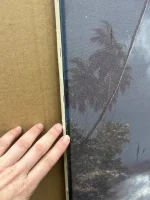
Ok, just took this. I tried to attach a 4 sec video and it wont let me.
The drops are kinda glossy, but background is still matte. And there is a slight ring around some. So I guess #2 and a little bit of #1?
For the varnish test, I did it on a drop that was at the very edge of the picture, on the faded part, so I think it should have worked. I used a gamvar gloss made for oils and acrylics. Is there a printed giclee version I should try? I don't know much about the printing arts.
As annoying as this project is, it is also interesting on a science level. Now I just want to know for my own knowledge. What do you think?
 

Attachments

  • IMG_3093.webp
    IMG_3093.webp
    262.2 KB · Views: 35
  • IMG_3094.webp
    IMG_3094.webp
    188.2 KB · Views: 29
I can blow these up quite a bit and it appears that there are tidelines where the substance (whatever it is) did lift or go into solution and is concentrated at the perimeteres of the drops.
I also see a lot of crazing in the surface finish/image outside the drops.

Just observations as I have no idea as to what that might mean in regards to any restorative efforts.
 
"I personally would absolute toss it and call it a day, in fact I have tried to convince the owner this. But of course its her husbands super favorite and has more sentimental value than just the image its self. So she does not want a replacement (I have found one), or a scan and reprint (yes yes I know this is wrong!), or ANYTHING but this exact canvas."

And you're done, you've gone the extra mile, and it's time to send her to a conservator.

I had a customer in this past week with a 100+ year old double opening frame that looked like a cabinet maker had made it. It had been dropped and the glass was broken. The art work was an old print that looked like it was ready to crumble. The back of the frame had two pieces of wood nailed across it which may have been the only stability the thing had. He wanted me to take it apart and replace the glass. The only problem I had was having a nice discussion and politely refusing. Experience teaches us how to have these discussions and remain friends.
 
Saying No can be a very liberating thing to do. We have to understand what our real capabilities and responsibilities are, and act appropriately. If I can't or won't do something a customer needs, at least I can give them some information to help them solve their problem. In a case like this, recommending a conservator is that information. You do not have a responsibility to make the customer's problem your problem.
:cool: Rick
I just had to write an email explaining to a customer that I was not going to "just glue" a ceramic art piece onto a piece of plywood with a frame around the plywood.
She sent me a photo of one a friend of hers had done in the past.

I had to politely describe the difference between hobby/DIY framing and a typical framing shop.
Also, that I don't have the equipment or materials to cut plywood panels nor mill frame mouldings from raw wood and stain them match something a DIYer did in their home shop years ago.
Most framers are not woodworkers.

Not saying that it can't be done that way professionally, we have members here who are spectacular framers and woodworkers.

My point is that we can't all be everything to everybody, and it is OK to just say "Sorry, I can't help you."
And at least offer to guide them to someone who might.
 
My point is that we can't all be everything to everybody, and it is OK to just say "Sorry, I can't help you."
And at least offer to guide them to someone who might.
That last sentiment can make all the difference to a potential client. A curt, "no, I don't do that" leaves a bad impression and the grape vine will work it wonders, but sometimes they make it so tempting to hit their ass with the door. We've had multiple clients come back with something we can frame quite some time after our initial fruitless meeting because we guided them to someone with the skills they need or helped them problem-solve at the cost of five to ten mintues out of our day.
 
Back
Top